• 972-800-8423
Atlas Restoration Contractors
  • Commercial
    • Replacement & Installation
    • Storm Restoration
    • Maintenance & Repair
  • Residential
    • Replacement & Installation
    • Storm Restoration
    • Maintenance & Repair
  • Gallery
  • About Us
    • Areas We Serve
      • Dallas-Fort Worth
      • Austin
      • Houston
      • San Antonio
    • Testimonials
    • Our Team
    • Blog
  • Contact
  • Menu Menu

Roofing for Strip Malls and Multi-Tenant Retail: How to Avoid Constant Tenant Complaints and Product-Damage Claims

Strip mall roofing problems rarely announce themselves with a single dramatic failure. They build. A slow drip that gets patched in one tenant’s space turns into a water stain in the neighboring suite three months later, then a product-damage claim after the next hard storm. By the time a property owner is fielding calls from two or three tenants simultaneously, the roof has usually been deteriorating for well over a year. Understanding what makes multi-tenant retail roofing properties particularly vulnerable, and what proactive management actually looks like in practice, is what separates owners who maintain stable occupancy from those who spend the year in reactive mode.

Why Strip Mall Roofs Carry a Different Kind of Risk

Multi-tenant retail roofing comes with risk factors that single-occupancy commercial buildings don’t face in the same way. The exposure isn’t limited to weather. It extends to lease obligations, liability, and the kind of occupancy stability that makes a retail center worth owning long-term.

One Continuous Roof, Multiple Points of Failure

Most strip malls share a single continuous flat or low-slope roof system that spans every tenant space in the row. A seam failure or drainage problem in one section can push moisture laterally into adjacent units, meaning tenants experience leaks well away from where the roof was actually compromised. HVAC curbs, vents, and shared drainage runs create dozens of penetrations across the membrane surface, each a potential failure path. As the system ages, those vulnerabilities don’t stabilize. They compound. Atlas’s commercial roofing services are designed around exactly this kind of multi-point risk profile, not the simpler calculus of a single-tenant building.

The Compounded Liability Risk

Commercial leases typically hold property owners responsible for maintaining the building envelope in a weathertight condition. When a retail tenant’s inventory or equipment is damaged by water intrusion, the conversation stops being about roofing and starts being about lease compliance. A documented pattern of unresolved leak complaints becomes a negotiating lever at renewal time and, in more serious situations, grounds for a formal damage claim. Multi-tenant retail roofing failures aren’t just a maintenance problem. They’re a financial performance problem with consequences that compound with every year of deferred attention.

What Triggers the Complaint Cycle

The sequence is consistent enough across properties that it’s worth tracing. Strip mall property managers tend to receive the same kinds of calls in the same order, and the root cause is almost always a roof that hasn’t received consistent, programmatic attention.

Deferred Attention and the Seam Problem

Commercial flat roofs depend on intact seams and functional drainage to perform reliably over time. When seams at penetrations, HVAC curbs, and perimeter flashing go years without an evaluation, small separations begin allowing moisture to track laterally beneath the membrane. Water migrates along insulation boards and deck materials before finding an exit point into a tenant space, which means what appears inside a retail suite is rarely directly below where the roof was compromised. By the time a leak is visible to a tenant, the moisture has often been moving for months. Regular commercial roof maintenance and repair closes that gap before anyone starts making calls.

When Leaks Become Product-Damage Claims

Once water reaches the interior of a retail space, inventory near the path of intrusion is at immediate risk. Food service tenants, clothing retailers, and any business with boxed products stored near exterior walls or below drainage runs can see merchandise written off quickly after a single weather event. These are the claims that escalate beyond maintenance budgets and into property management conversations. A property owner who can document a consistent, responsive maintenance history is in a fundamentally different position than one fielding the same complaint for the third or fourth time. The roof is either being managed proactively or reactively, and the cost difference between those two postures accumulates significantly over any five-year ownership window.

When retail tenant calls about leaks or product damage start coming in, the roof has usually been showing warning signs for months. Atlas Restoration works with strip mall owners and property managers across Texas to identify those conditions before they affect occupancy.

Schedule a Roof Health Check

The Coating Solution That Changes the Math on Strip Mall Roofing

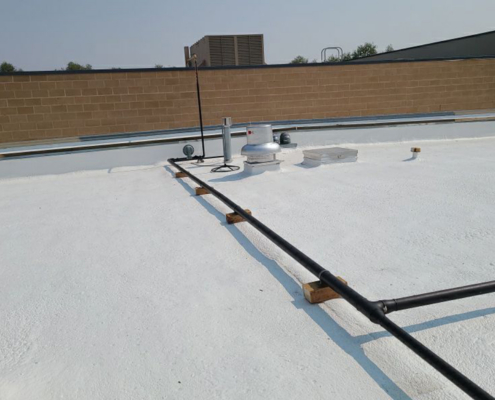
One of the most consistent findings from strip mall roof evaluations is that the existing system is structurally intact but losing the battle at seams, penetrations, and the field membrane surface. Full replacement isn’t warranted, but continued patch work isn’t sustainable either. A fluid-applied roof coating applied across the whole surface addresses all of those vulnerabilities in a single scope of work.

How a Coating Replaces the Repair Cycle

Individual repairs address single failure points. A coating system applied to the full membrane surface seals every seam and penetration simultaneously, creates a new continuous waterproofing layer, and carries its own manufacturer-backed warranty. For strip mall owners dealing with escalating repair costs and recurring tenant complaints, a well-applied coating effectively resets the clock on the existing roof without the capital outlay or operational disruption of a full tear-off. Understanding when a coating makes more financial sense than a full replacement is a critical part of planning any retail roof investment, and that answer should always come from an evaluation of actual conditions, not a default contractor recommendation.

Minimizing Disruption to Occupied Spaces

Full roof replacements on occupied retail centers are operationally difficult to execute without impacting tenants. Equipment noise, debris staging, and extended project timelines create friction in tenant relationships that are already strained when complaints have been ongoing. A coating application involves no tear-off, significantly shorter timelines, and minimal disruption to the spaces below. For property managers trying to fix a real roof problem without destabilizing active leases, the operational case for a coating is nearly as compelling as the financial one.

The Pattern Atlas Sees Most Often on Commercial Roofing Strip Mall Properties

The situations that come to Atlas follow a recognizable arc: a property with years of growing repair calls, a service history that reads like the same few problems recurring in different locations, and tenants who’ve begun documenting complaints in writing. After a thorough evaluation, the underlying condition is almost always a membrane that has failed at its seams and penetrations across the full field, not just in the isolated spots that got patched. A coating applied to that system addresses the entire surface at once, eliminates the recurring failure points, and stops the complaint cycle at its source rather than managing it one call at a time.

What Retail Center Roof Maintenance Should Actually Look Like

Retail center roof maintenance isn’t dispatching a crew when a complaint comes in. A consistent program creates the documentation trail and early detection capability that keeps small conditions from becoming tenant emergencies, damage claims, or lease non-renewal conversations.

Regular Roof Health Checks

A proper Roof Health Check on a strip mall roofing system should cover the full membrane field, all HVAC curbs and penetrations, perimeter flashing and edge metal, and the drainage system from internal drains through downspouts to the building perimeter. The goal is identifying conditions that precede leaks, not confirming the ones that have already happened. Findings should be documented with photos and thermal imaging where subsurface moisture infiltration is suspected beneath the surface, because what isn’t visible from above can still be actively migrating toward a tenant ceiling.

Post-Storm Evaluations

Texas weather events, whether hail, high wind, or sustained heavy rain, create surface conditions that accelerate failure in a system that was already aging. An evaluation after a significant storm catches hail impact at seams, displaced flashing, and debris-related drainage blockages while they’re still addressable through targeted repair rather than larger intervention. Property owners who schedule routine commercial storm restoration evaluations after weather events build a documented maintenance record that holds real weight when a tenant raises a damage dispute or a lease renewal becomes a negotiation.

Drainage and Penetration Are Always the Priority

On any flat or low-slope commercial roof, drainage performance and penetration integrity represent the highest concentration of risk. Slow or blocked drainage creates ponding conditions that stress the membrane over time and accelerate deterioration. Gaps at HVAC curbs, vents, and exhaust penetrations create direct moisture pathways into the building. These areas deserve priority attention at every maintenance visit, not only when something is actively failing.

The Right Strategy Protects the Whole Investment

Strip mall roofing is ultimately about protecting what the property delivers: a stable, functional retail environment where tenants aren’t managing building problems alongside running their businesses. The owners who hold occupancy and avoid damage claims aren’t necessarily the ones who spend the most on their roofs. They’re the ones who invest at the right time, based on what the roof actually needs, with a partner who evaluates first and recommends based on conditions rather than defaults.

Atlas Restoration works with retail center owners and property managers across Texas, including the Dallas-Fort Worth area where strip mall inventory is dense and weather exposure is significant. From Roof Health Checks and coating applications to post-storm evaluations and structured maintenance programs, the work starts with an honest evaluation of what the system actually needs. Reach out to schedule your Roof Health Check and find out exactly where your property stands.

Share This Post

  • Share on Facebook
  • Share on X
  • Share on WhatsApp
  • Share on Pinterest
  • Share on LinkedIn
  • Share on Tumblr
  • Share on Vk
  • Share on Reddit
  • Share by Mail

More Like This

White Commercial Roof Side View With Piping

Why Older Dallas Commercial Buildings Benefit From Strategic Roof Restoration

Commercial Roofing Dallas
https://restorewithatlas.com/wp-content/uploads/2026/04/White-Commercial-Roof-side-view-with-piping.jpg 1250 2000 Abstrakt Marketing /wp-content/uploads/2026/02/Atlas-Logo-COLOR.png Abstrakt Marketing2026-07-14 16:59:132026-08-26 08:36:18Why Older Dallas Commercial Buildings Benefit From Strategic Roof Restoration

Categories

  • Commercial Roofing Coatings
  • Commercial Roofing Dallas
  • Maintenance and Repair
  • Roof Evaluations
Atlas Logo White Nopadding

Stay Connected

What We Do

Commercial Roofing 

Residential Roofing 

About Us

Our Gallery

Contact Us

259 Ranch Trail, Ste A
Rockwall, TX 75032

972-800-8423

[email protected]

Website by Abstrakt Marketing Group ©
  • Privacy Policy
  • Sitemap
Scroll to top Scroll to top Scroll to top

This site uses cookies. By continuing to browse the site, you are agreeing to our use of cookies.

AcceptLearn more

Cookie and Privacy Settings


How we use cookies

We may request cookies to be set on your device. We use cookies to let us know when you visit our websites, how you interact with us, to enrich your user experience, and to customize your relationship with our website.

Click on the different category headings to find out more. You can also change some of your preferences. Note that blocking some types of cookies may impact your experience on our websites and the services we are able to offer.

Essential Website Cookies

These cookies are strictly necessary to provide you with services available through our website and to use some of its features.

Because these cookies are strictly necessary to deliver the website, refusing them will have impact how our site functions. You always can block or delete cookies by changing your browser settings and force blocking all cookies on this website. But this will always prompt you to accept/refuse cookies when revisiting our site.

We fully respect if you want to refuse cookies but to avoid asking you again and again kindly allow us to store a cookie for that. You are free to opt out any time or opt in for other cookies to get a better experience. If you refuse cookies we will remove all set cookies in our domain.

We provide you with a list of stored cookies on your computer in our domain so you can check what we stored. Due to security reasons we are not able to show or modify cookies from other domains. You can check these in your browser security settings.

Other external services

We also use different external services like Google Webfonts, Google Maps, and external Video providers. Since these providers may collect personal data like your IP address we allow you to block them here. Please be aware that this might heavily reduce the functionality and appearance of our site. Changes will take effect once you reload the page.

Google Webfont Settings:

Google Map Settings:

Google reCaptcha Settings:

Vimeo and Youtube video embeds:

Accept settingsHide notification only